CH 03 · Controllers
PS5 controller tester
Connect your DualSense to a PC with USB or Bluetooth, then press its buttons and move the sticks. The test shows what your browser reports; nothing leaves your device.
DualSense wireless controller (PS5) tester
Shows every button, trigger and stick of a controller live. Press Start the test, then press any button on the controller: browsers hide a controller from a page until a button is pressed.
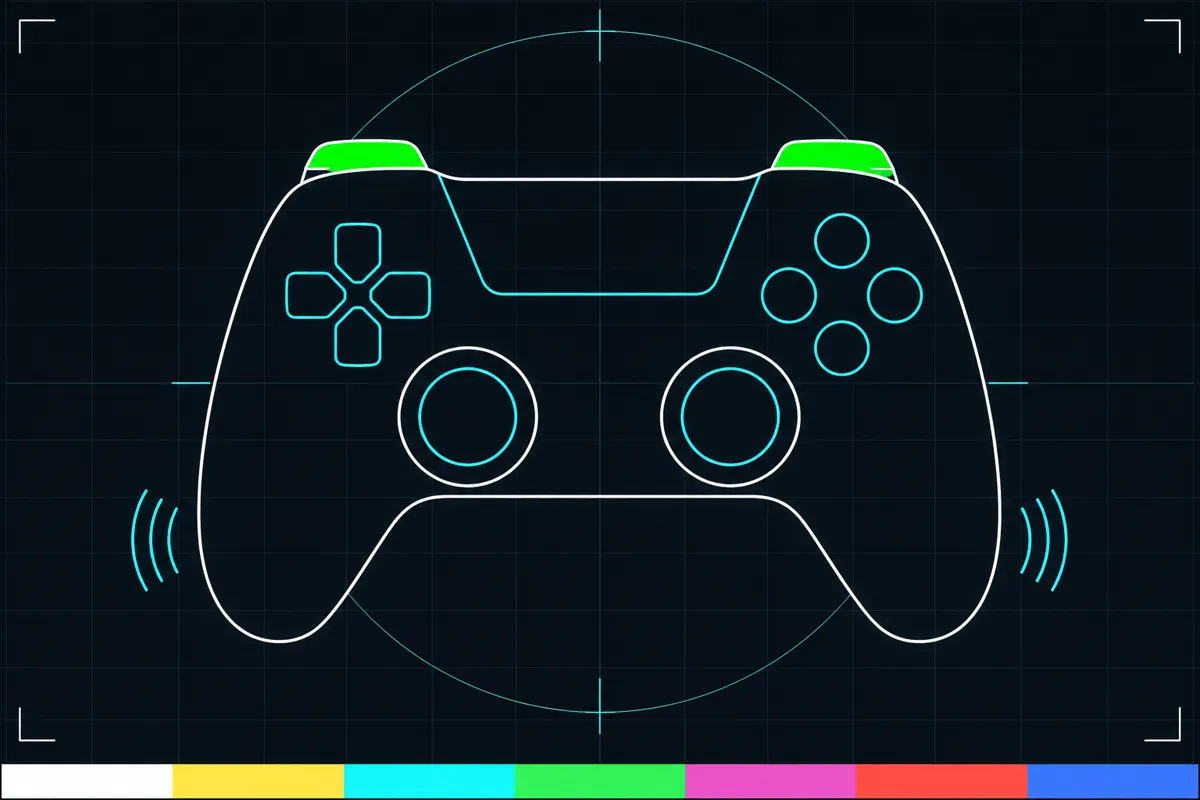
DualSense buttons in the browser
The DualSense has familiar PlayStation controls, plus the Create button, Options button, PS button, touch pad button and Mute button. Press a control while the test is open to see whether the browser reports it. The page uses PlayStation button names so you can match each reading to the controller.
The browser's standard button order is Cross, Circle, Square, Triangle, L1, R1, L2, R2, Create button, Options button, L3 (left stick press), R3 (right stick press), Directional button up, Directional button down, Directional button left, Directional button right, and PS button. The touch pad button and Mute button are not reported by the browser in this test, so no reading for either one does not by itself mean the control is broken.
The DualSense also has adaptive triggers and motion sensors. This test focuses on the readings the browser provides, so it does not show a separate reading for every feature. A feature that has no reading here cannot be judged from this page.
What each reading means
The button readings show which reported control the browser detects when you press it. If the right label responds to your press, the browser is receiving that button input. If a label does not respond, the browser has not reported that press during the test.
The page also shows the controller's stick readings as you move the sticks. Move each stick and watch its reading change, then let it go and see whether the display reflects its position. This tells you what input the browser receives, not whether the controller meets a particular performance threshold.
The vibration check uses the DualSense's vibration motors. If the test can trigger vibration, the controller responds to that request. Vibration may not be available through every browser connection, so no vibration response alone does not establish that the motors have failed.
Connect and run the test
Connect the DualSense to your PC using USB or Bluetooth. Open this test, then press the PlayStation buttons and move both sticks while watching the readings. Try the Create button, Options button and PS button too, since these are part of the browser's reported button order.
Browser mapping describes how the browser presents the controller's inputs in the test. The tester uses the mapping shown for the connected controller, so a button label or position can depend on what the browser reports. Use the on-page labels and press one control at a time to identify its reading.
When a reading is missing
If a button or stick does not respond, first check whether it is one of the two controls this test does not report: the touch pad button or Mute button. For other missing readings, reconnect the controller and try the test again. A missing response means the browser did not report that input; it does not prove by itself that the controller is faulty.
If the controller does not connect or the test cannot read it, this page links to a controller connection fix guide. Follow that guide for the next checks. If only vibration is missing, remember that browser support for vibration can vary, so the result may reflect the connection or browser rather than a failed motor.
Browser support
| Browser | Runs |
|---|---|
| Chrome and Edge on a computer | Yes |
| Firefox on a computer | PartlyNo controller vibration. |
| Safari on a Mac | Yes |
| Safari on iPhone | PartlyNo controller vibration. Needs a paired controller. |
| Safari on iPad | PartlyNo controller vibration. Needs a paired controller. |
| Chrome on Android | PartlyNeeds a paired controller. |
| Samsung Internet | PartlyNeeds a paired controller. |
| Browsers inside apps | PartlyNo controller vibration. |
Source: MDN browser-compat-data 8.1.8 · checked November 6, 2026
Questions
Can this PS5 controller tester check the Create and Options buttons?
Yes. Create and Options are included in the browser's reported button order. Press each while the test is open and check whether its named reading responds.
Does the tester show the PS button?
The PS button is included in the browser's standard button order for this controller. The test can show it when the browser reports the press.
Why is there no touch pad or Mute button reading?
The browser does not report the touch pad button or the Mute button in this test. Their absence from the readings does not tell you whether either control works elsewhere.
Can I test DualSense vibration on a PC?
The DualSense has vibration motors, and the tester can check whether a vibration request produces a response. If it does not vibrate, browser or connection support may be the reason, so this result alone cannot confirm a motor fault.
Does this test check adaptive triggers and motion sensors?
The DualSense has adaptive triggers and motion sensors, but this page shows the readings the browser reports. It does not provide a separate reading for every controller feature, so an unshown feature cannot be judged here.
Why does the browser show a different button mapping?
The tester displays the controller mapping reported by the browser. Use the PlayStation labels on the page and press controls one at a time to see which reported reading matches each press.